| Frank Lucas: Profile & Legacy | |
|---|---|
| Full Name | Frank Lucas |
| Primary Alias | Original Gangster |
| Mentored By | Bumpy Johnson |
| Main Product | Blue Magic Heroin |
| Spouse | Julianna Farrait |
| Peak Net Worth | $50 Million (estimated) |
| Date of Death | May 13, 2019 |
The 2007 blockbuster American Gangster introduced the world to a specific version of Frank Lucas. Portrayed with cold charisma by Denzel Washington, the movie presented Lucas as a criminal pioneer who revolutionized the drug trade by cutting out the middleman.
However, beneath the cinematic veneer lies a narrative far more complex. While the film captures the ambition of the man who succeeded Bumpy Johnson, it also perpetuates myths that have obscured the historical reality for decades—realities first brought to light in the original 2000 New York Magazine profile ‘The Return of Superfly’. To understand the real Frank Lucas, we must look past the script and into the records of the Vietnam War era and the actual streets of Harlem.
BLUE MAGIC: THE BUSINESS OF HEROIN IN HARLEM
Frank Lucas didn’t just sell drugs; he sold a brand. That brand was Blue Magic. Before Lucas, the heroin on the streets was often stepped on so many times it retained only 1% to 3% purity. Lucas disrupted the market by importing 10% pure heroin directly from the Golden Triangle in Southeast Asia.
The Model: By bypassing the Italian Mafia, Lucas could offer a “finer product at a better price.”
The Profit: At the height of his power, Lucas boasted of making $1 million a day.
The Impact: The potency of Blue Magic heroin was so high that it was responsible for a wave of overdoses across the tri-state area, fundamentally changing the landscape of drug addiction in New York.
Lucas viewed his operation as a “perversion of the American way,” applying legitimate corporate strategies to an illicit trade. This professionalism, learned from his mentor Bumpy Johnson, allowed him to dominate Harlem until the mid-1970s.
This professionalism, learned from his mentor Bumpy Johnson, allowed him to dominate Harlem until the mid-1970s. While Lucas preferred the ‘lone wolf’ model he learned from Bumpy Johnson, the 1970s Harlem scene was increasingly dominated by ‘The Council,’ led by figures like Nicky Barnes and the business-minded Guy Fisher.
FACT-CHECKING THE COFFINS: FRANK LUCAS VS. IKE ATKINSON
Perhaps the most famous scene in the Frank Lucas movie is the image of heroin being smuggled into the U.S. inside the coffins of fallen American soldiers. While Lucas claimed this was true in his 2010 autobiography Original Gangster, his primary logistical partner, Ike Atkinson (known as “Sergeant Smack”), vehemently denied it.
According to Atkinson and federal investigations:
The Real Method: Drugs were hidden in furniture, false-bottomed bags, and teak wood shipments—not cadavers.
The “Ghoulish” Myth: The idea of using the dead was likely a dramatic embellishment. Smuggling drugs next to bodies would have invited intense scrutiny from military morticians, a risk the calculating Lucas and Atkinson would likely not have taken.
The Connection: While the Vietnam War provided the perfect cover for transport on military aircraft, the “coffin myth” remains one of the greatest discrepancies between Hollywood fiction and criminal fact.

THE REAL JULIANNA FARRAIT: BEYOND THE MISS PUERTO RICO MYTH
One of the most persistent searches is for Frank Lucas wife, Julianna Farrait. The film depicts her as “Eva,” a Miss Puerto Rico winner. In reality, while Julianna was a beauty queen, she was a “Homecoming Queen”—not Miss Puerto Rico.
The couple met on a flight from Puerto Rico to New York in 1967. Lucas was instantly taken by her, but he felt she needed to be “fixed up” to look like the wife of a kingpin. Together, they became known as the “Black Bonnie and Clyde.”
THE CHINCHILLA COAT INCIDENT
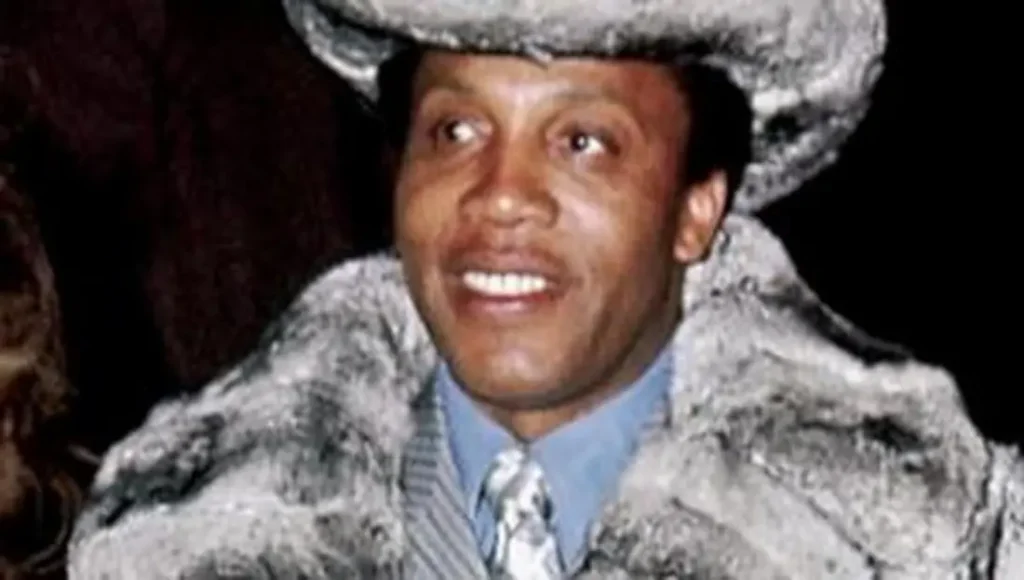
The legendary $125,000 chinchilla coat and $40,000 hat were actually gifts from Julianna to Frank for the 1971 Muhammad Ali-Joe Frazier fight. This act of opulence was a fatal mistake. As detective Richie Roberts noted, showing off a coat that cost five years’ worth of a policeman’s salary made Lucas a “marked man.”
FAMILY AND THE FALL
Their daughter, Francine Lucas-Sinclair, witnessed the dark side of this life firsthand. She was present during a 1983 FBI raid in Las Vegas when her mother was arrested during a drug deal. Despite the “Bonnie and Clyde” loyalty, Julianna eventually served significant time, including a five-year sentence as late as 2012 for attempting to sell cocaine in Puerto Rico.
FRANK LUCAS NET WORTH: FROM $50 MILLION TO ZERO
At his Frank Lucas peak net worth, the kingpin claimed to have $52 million in Cayman Island banks and millions more in property and assets. However, the raid on January 28, 1975, in Teaneck, New Jersey, signaled the end of the wealth. According to official federal records regarding the 1975 Teaneck raid, federal agents, led by Richie Roberts, seized $584,000 in cash during the initial sweep.
The Raid: Federal agents, led by Richie Roberts, seized $584,000 in cash during the initial sweep.
The Asset Seizure: Eventually, the government moved to seize over $37 million in assets.
The Result: By the time of his death, the once-fabled Frank Lucas net worth had evaporated. He spent his final years in a wheelchair, far from the mahogany-row offices and private jets of his youth.
THE END OF AN ERA: HOW DID FRANK LUCAS DIE?
For those asking about the Frank Lucas cause of death, the story ends without the violence that defined his rise. Lucas died of natural causes on May 13, 2019, in New Jersey. He was 88 years old.
His death marked the final disappearance of the 1970s Harlem underworld. While he outlived many of his rivals—including his arch-nemesis and the head of The Council, Nicky Barnes (who died in 2012)—his legacy remains a cautionary tale about the intersection of ambition, brand-building, and the inevitable reach of the law.
The fall of the 1970s kingpins created a massive power vacuum in Harlem, eventually paving the way for the more chaotic and violent era of Alpo Martinez and Rich Porter in the mid-1980s.