| The Gangster Disciples: Corporate Profile | |
|---|---|
| Chairman | Larry Hoover |
| Operational Base | Dixon Correctional Center (Headquarters) |
| Estimated Membership | 30,000 members |
| Annual Revenue | $100 Million |
| Official Colors | Blue and Black |
| Primary Identity Code | 74 (G=7, D=4) |
The transition of the Gangster Disciples from a street-level alliance—the origins of which we explored in our previous article on Larry Hoover and David Barksdale—to a nationwide organization is a masterclass in criminal logistics. Under the leadership of Larry Hoover, who functioned as a shadow “CEO,” the gang evolved into a bureaucratic machine with an estimated 30,000 members. This expansion was not chaotic; it was a calculated transformation that redefined the very fabric of Chicago’s underworld, turning street hustle into a corporate-style empire.
THE CORPORATE HIERARCHY: LARRY HOOVER AND THE BOARD OF DIRECTORS
Authorities, supported by historical data from the Chicago Crime Commission, have often described the Gangster Disciples hierarchy as mirroring that of a Fortune 500 company. The level of efficiency and discipline within the organization allowed it to serve “customers” 24 hours a day, an operational model that investigators frequently compared to global franchises like McDonald’s. This high-stakes corporate approach to the streets was a precursor to the legendary structure later adopted by Kenneth “Supreme” McGriff and the Supreme Team in Queens.
WHO STARTED THE GANGSTER DISCIPLES? THE ALLIANCE OF LARRY HOOVER AND DAVID BARKSDALE
The alliance between Larry Hoover and David Barksdale was built on mutual respect and a shared vision of disciplined growth. Barksdale’s street legend provided the lineage and the “King” status, while Hoover’s strategic mind provided the blueprint for the future.
This merger was the spark that eventually led to a national network. It created a hierarchy that would later influence organizations like the BMF (Big Meech, Southwest T and Tonesa Welch), which adopted similar “corporate” structures to manage their operations across state lines. The BGDN was not just a crew; it was a nation with its own laws, symbols, and a rigid chain of command that focused on the Chicago territory as its sovereign base.
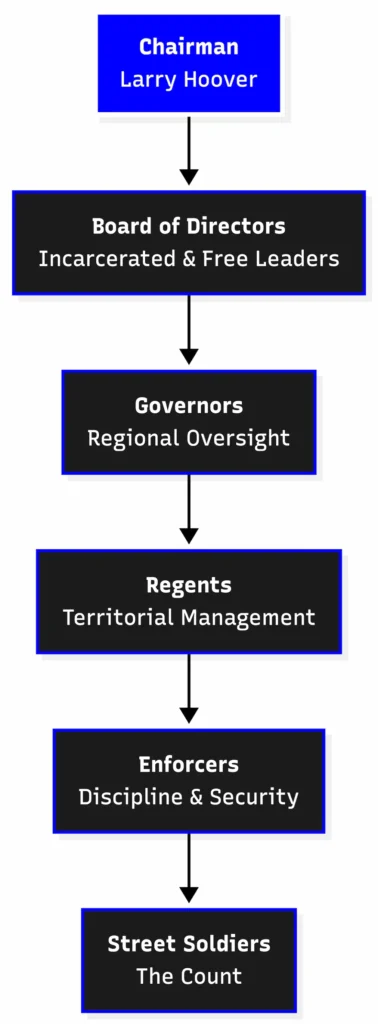
At the pinnacle of this pyramid sat Larry Hoover as the Chairman. Below him was a sophisticated Board of Directors, split between those incarcerated and those operating on the outside. The management of the Chicago territory was further subdivided among Governors, Regents, and Enforcers, each responsible for a specific “Count” of members. Remarkably, Hoover managed this entire apparatus from the Dixon Correctional Center, which effectively served as the organization’s operational headquarters until the federal crackdown in 1995. Official details regarding the Operation Family Ties indictment from the U.S. Department of Justice reveal how messily this corporate veil was eventually pierced.
THE BILLION-DOLLAR ECONOMY: STREET TAX AND REVENUE STREAMS
The financial scale of the empire was staggering, with reports indicating that the organization generated approximately $100 million in revenue per year. This massive wealth was not solely the result of direct sales; it was maintained through a rigorous internal economy known as the “Street Tax.”
Under this system, the organization would take a 70% cut of profits from street-level dealers to fund legal defenses, administrative costs, and internal welfare. This disciplined economic model served as a blueprint for later organizations like the BMF (Big Meech, Southwest T and Tonesa Welch), which similarly professionalized their distribution networks across the United States. Much like the legendary Frank Lucas had done decades prior, Hoover understood that absolute control over the revenue stream was the key to longevity.
DECODING THE LITERATURE: THE CONSTITUTION AND THE 16 LAWS
The Gangster Disciples were unique in their reliance on written documentation, collectively referred to as “Gangster Disciple literature 1-16.” This included a formal Gangster Constitution and a strict code of conduct consisting of the 16 laws written by Hoover himself.
These laws enforced absolute silence and secrecy, often using the famous “Duck” metaphor: “If a duck didn’t quack, it wouldn’t get shot.” The code also strictly prohibited the use of hard drugs among its members and mandated total respect for the chain of command. Any violation of these codes could result in sanctions ranging from fines to capital punishment, a level of internal discipline far more rigid than that of the council led by Leroy “Nicky” Barnes in Harlem.
SYMBOLS AND SECRETS: THE MEANING OF THE 6-POINTED STAR
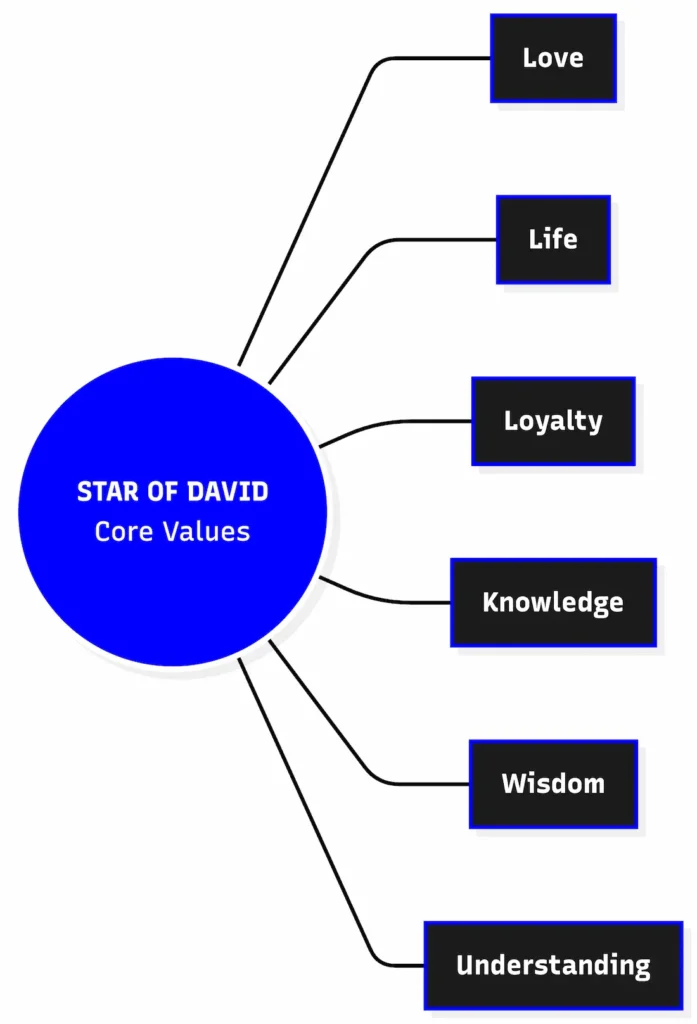
The visual identity of the organization is deeply rooted in complex symbolism. The most prominent symbol is the six-pointed star (Star of David), which serves as a tribute to the legacy of King David Barksdale. To the initiated, the GD 6 point star meaning is tied to the six core principles: Love, Life, Loyalty, Knowledge, Wisdom, and Understanding.
Accompanying the star are the upward pitchforks, which represent evolution and the collective effort to overcome adversity. The primary Gangster Disciples colors are blue and black, which define its membership within the broader Folk Nation alliance. This affiliation—further detailed in academic resources from the National Gang Center—is physically manifested through the rule of “right side,” where members wear their hats, tilt their clothing, or cross their arms to the right to signal their loyalty.
ALPHA-NUMERIC CODES: UNDERSTANDING THE 74 AND THE 721 SLANG
Communication within the empire often utilized numeric ciphers to maintain security. The most common is the Code 74, where G is the 7th letter and D is the 4th, serving as a shorthand for “Gangster Disciples.”
Confusion often arises regarding the 721 meaning. While some might associate it with internal codes, it is primarily an investigative identifier used by police Gang Units to categorize members. Distinguishing between internal ritual codes like 74 and external investigative labels is crucial for understanding the interplay between the streets and law enforcement. This level of technical complexity in communication mirrors the focus on image and discipline seen in other major figures like Guy Fisher.
GANG SIGNS AND TATTOOS: THE VISUAL IDENTITY OF THE FOLKS NATION
Beyond written laws, the organization utilized a complex system of gang signs for Gangster Disciples to communicate in public or during high-stakes situations. The most recognizable is known as “The Gates,” a hand signal that communicates affiliation and status within the Folk Nation.
For many members, loyalty is a permanent commitment marked by Gangster Disciples tattoos. These markings, often featuring the star or pitchforks, are viewed as a visual contract and a lifelong oath to the “Chairman” and the principles of Growth & Development (G&D). In the world of Larry Hoover, the skin becomes the canvas upon which the empire’s history and laws are permanently recorded.